

Introduction
slotmirror keeps several calendars in sync, so that nobody books you twice. It copies your events from one calendar into your others as “Busy” blocks, or with as much detail as you choose. It supports Microsoft 365 and Google Calendar and runs in your own Cloudflare account, on the free plan.
It is for people with more than one calendar: consultants with client tenants, founders with two companies, anyone with a work and a private calendar. You host it yourself, so your calendar tokens stay with you and not with a sync service.
What it does
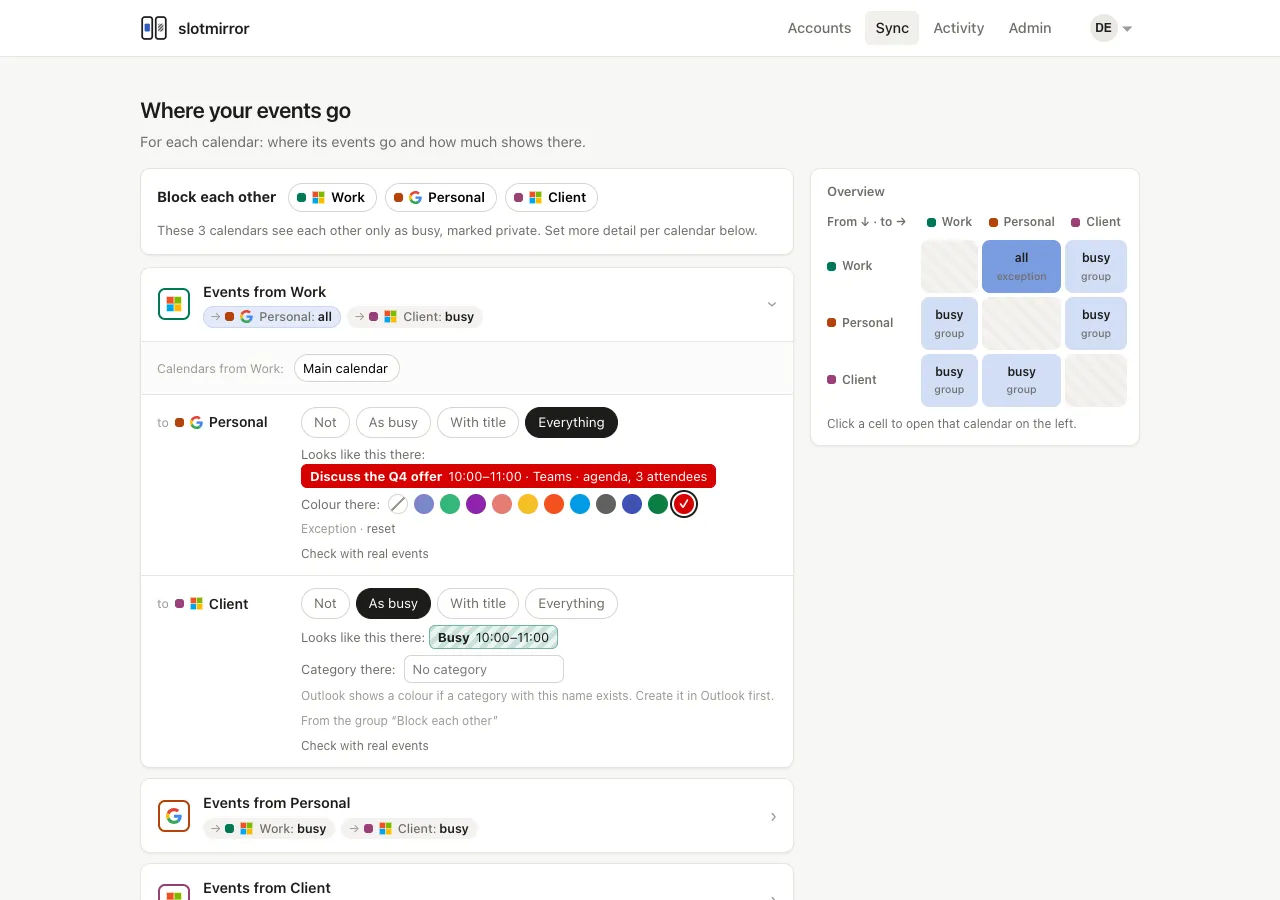
Section titled “What it does”- One group for the common case. Put your calendars in the block group, and each sees the others only as “Busy”, marked private.
- More detail where you want it. Per calendar and target you choose: not at all, as busy, with title, or everything.
- Several calendars per account. Next to the main calendar you can add others, such as a subscribed team schedule. Targets are always the main calendars.
- Changes within seconds. Microsoft and Google notify your deployment when a calendar changes. See Push notifications.
- Recurring events are exact. Each occurrence is mirrored on its own.
- Only differences are written. Every run compares what each target should contain with what it does contain. Blocks are never rebuilt.
- Privacy limits for teams. An admin can cap how much detail moves between work calendars and private ones. See Organisations.
- Audit log. Sign-ins, changes and sync runs with counts and error codes, never event content.
- English and German in the app.
How it works
Section titled “How it works”A change in a source calendar reaches your Worker as a notification. The Worker reads the changed events and writes the matching blocks into the target calendars.
- Worker (Hono): dashboard pages, OAuth callbacks, webhook endpoints and the cron trigger.
- D1: orgs, users, accounts, calendars, rules and the audit log.
- Durable Object
AccountSync, one per connected account: encrypted tokens, the provider watches and the queue of rules to run. A rule runs in the instance of its target account and reads events from the instance of its source account. - Markers instead of a mapping table. Each block carries a marker with the rule and the source occurrence. The target calendar itself records which blocks exist, so no mapping table can drift.
- One block per event. If several rules would write equal blocks (same times, same title) into one calendar, for example from two calendars that both hold a match, only one is written.